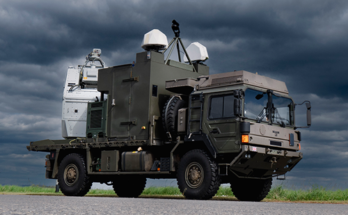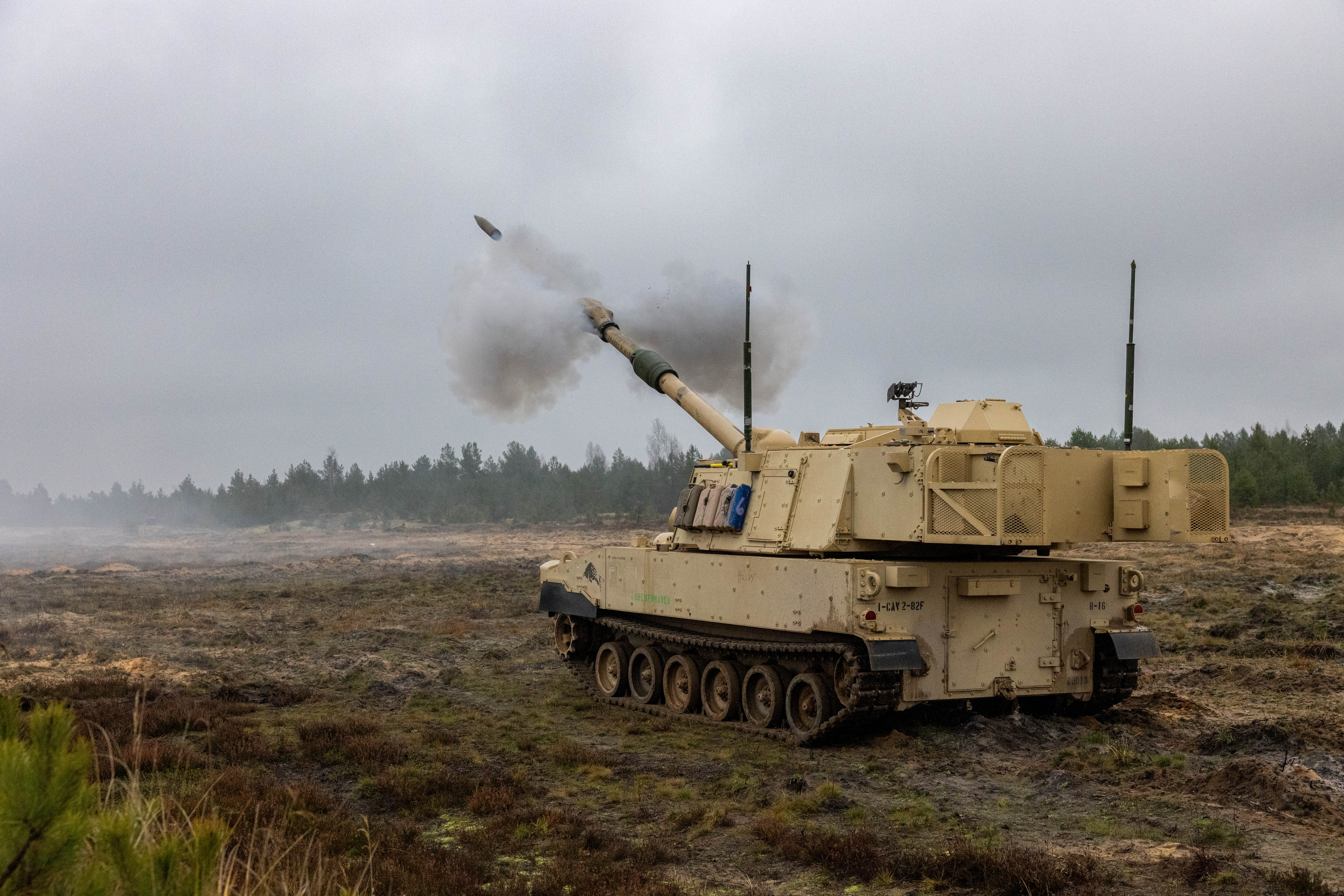
BAE Systems unveiled its Multi-Domain Artillery Cannon System (MDACS) at the Association of the United States Army’s LANPAC Symposium on May 15, 2026, offering a potential solution to the crippling costs of modern air defense. Recent conflicts in Ukraine and the Middle East have demonstrated that while cutting-edge platforms like the MIM-104 Patriot, Iron Dome, THAAD, and David’s Sling are highly effective, the sustainability of these and similar systems has proven to be costly and, in some instances, flawed. Firing million-dollar interceptors at low-cost drones and rockets has created a severe cost imbalance for Western militaries. The MDACS platform aims to bridge this capability gap, occupying the critical middle ground between cost-prohibitive, high-tier missile interceptors and short-range terminal defense systems like the Counter-Rocket, Artillery, and Mortar (C-RAM) or Rheinmetall’s Oerlikon Skyranger.
The Cost Asymmetry Concern
Modern militaries have adapted to a proliferation of new technologies in the air domain with sophisticated, missile-based, stationary anti-air systems such as Iron Dome and MIM-104 Patriot batteries. Although these have been largely effective for the Israeli and U.S. militaries in the conflict with Iran, their success rate has been shown to be anywhere from 85% to over 90%, factors such as cost and munitions supply have proven to be the most hindering factors in the continued success of such air-defense systems. Iran’s Islamic Revolutionary Guard Corps (IRGC) Aerospace Force, the arm of the Iranian military apparatus responsible for the operation of its Unmanned Aerial Vehicle (UAV) fleet and its ballistic missile force, has adapted to its foe’s perceived limitations in air-defense; these systems cannot last in a war of attrition. Accordingly, they have incorporated the combat doctrine of launching numerous waves of dozens, even hundreds, of one-way attack drones and ballistic missiles in order to overwhelm air defenses, and in the longer term, deplete their adversary’s munitions stockpiles.
The strain on Israeli and U.S. anti-air defense systems has been noticeable since Operation Epic Fury began on February 28, 2026, as Iran launched several waves of one-way attack drones and ballistic missiles in response to Israeli and U.S. strikes on key Iranian military installations. The sustained attacks made a noticeable dent in air defense munition inventories in Israel and neighboring Arab countries, many of which count on U.S.-provided missiles.
Although exact costs are not made public, it is believed that the Israeli Iron Dome interceptors are priced at $100,000-$200,000 each, while the longer-range joint U.S.-Israeli developed Arrow 2 missile interceptors are estimated to cost around $3 million to $4 million each. Further, the U.S. produced Patriot and THAAD interceptor missiles cost upwards of $4 million and $12-$15 million, respectively; whereas the ballistic missiles they are designed to defeat, such as the Iranian Fateh-110 variant, cost approximately a few hundred thousand dollars to produce.
Procurement of these U.S.-produced munitions is also a significant hurdle, as the manufacturing process cannot keep pace with the current rate of use. As of December, 2025, the DoD has received approximately 270 Patriot Advanced Capability-3 (PAC-3) missiles per year since 2015, with an uptick of 20% to 600 PAC-3 missiles delivered in 2025. Additionally, the DoD awarded Lockheed Martin a multi-year deal with a goal of delivering approximately 2,000 PAC-3 missiles per year. This will go a long way to close the gap between operational needs and stockpiled munitions, but the reality is that this ambitious goal will take a significant amount of time to be achieved.
Can MDACS Close the Critical Gap?
BAE Systems believes that it has produced the solution to this potentially critical gap in air defense during a time of rapidly evolving battlefield scenarios. MDACS will be tailored to medium-range interception of drones, cruise missiles, and rotary- and fixed-wing aircraft. This system will consist of an artillery battery, much akin to traditional artillery pieces such as the PzH 2000, M109A7 Paladin, and the K9 Thunder, and supporting systems such as multi-function precision radars and multi-domain battle managers. Arguably, the most important aspect of the MDACS is the Hypervelocity Projectile (HVP), which is the critical aspect that allows a traditionally land-based targeting weapon system to become an anti-air defense tool. The 155mm projectile can exceed Mach 3 and will rely on kinetic impacts rather than explosives to destroy its targets. Data from a Congressional Research Service report indicates that, as of 2018, each HVP costs approximately $85,000, drastically less than interceptor missiles currently in use in C-UAS batteries.
MDACS can prove to be an important mid-range C-UAS option as other products such as Rheinmetall’s Oerlikon Skyranger vehicles and Northrop Grumman’s Short-Range Air Defense (SHORAD) system can only offer armament for short-range interception, such as 30mm and 35mm automatic cannons and chain guns. MDACS claimed capabilities of using its 155mm HVPs to strike targets at medium- to long-range can augment a location’s air defenses indefinitely. According to BAE Systems, it will be able to fire at a rate of eight rounds per minute, which will provide a high saturation of fire of radar-guided HVPs that will theoretically intercept large waves of drones or missiles like those currently seen in battlefields around the world. What makes this air-defense system more impressive is its high mobility, as it can be maneuvered anywhere in the world by a C-130 transport aircraft and deployed to locations where expensive air-defense systems are either impractical or simply too difficult to position, maintain, and supply. An MDACS system can essentially be treated as any other traditional artillery battery and placed in high-risk areas such as forward bases, temporary installations, or expeditionary deployments.
In December, 2024, the United States Army Rapid Capabilities and Critical Technologies Office (RCCTO) contracted BAE Systems to deliver eight MDACS batteries, four multi-function precision radar systems, two multi-domain battle managers, and at least 144 HVPs no later than Q4 in FY27 and operational demonstrations sometime in FY28.
A Necessary Alternative
Although established anti-air defense capabilities have been effective, they have proven to be expensive and difficult to replenish at current logistics operational timeframes. Needless to say, the optics of several multi-million dollar missiles intercepting attack drones valued at tens of thousands of dollars is not ideal during a time where budgetary constraints have hindered the federal government’s planning. The U.S. Army is counting on BAE Systems’ perceived mastery of ideas that have, for the most part, only been theoretical until recent times. Until MDACS and the HVPs can demonstrate their performance and worth to military officials, the truth is the DoD will have to continue to ration critical anti-air munitions until domestic production can catch up with the aggressive demand of modern battlefield necessities.

Juan Lopez pursued an undergraduate degree in Political Science with an emphasis in International Relations and a minor in Russian studies from the University of California, Riverside. Juan’s diverse background includes his work as a staffer in the U.S. House of Representatives and in federal law enforcement which gave him extensive experience and knowledge in federal government operations, international affairs, counter terrorism, and national security. His interests include land-based weapon systems, small arms, military fixed wing aircraft, and Latin American relations. He is proficient in the Spanish language at a native level.