When it comes to systems-based drone defense, mobility, adaptability, cost-per-shot value, and combat effectiveness are just some of the factors planners are considering, whether for fast-tracking development of certain technologies, issuing new RFPs to potential contractors, or deciding which systems to purchase and deploy.
Coming out of this ever-expanding playbook, and with so many variables in motion, the past few months have seen new evidence that the layered defense approach to air defense against unmanned systems, while maybe not the most economical, continues to be the most pragmatic strategy.
The simple fact of the matter is that the drone threat comes in a staggering variety of forms, and a defender can never be sure which one may be coming over the horizon. Profound differences in size, weight, speed, and offensive capabilities demand an equally expansive menu of possible responses. And this is all compounded exponentially by the growing menace of massed drone swarms.
In this environment, worldwide purchases are rising for a wide variety of programs incorporating radar, EO/IR sensors, fire-control, kinetic interceptors, jamming systems, directed energy, laser, high-power microwave, and 50mm weapons, for placement in multiple conflict zones and high-value locations.
In May, the U.S. Joint Interagency Task Force 401 (JITF-401) awarded a three-year, $500 million indefinite delivery/indefinite quantity contract to Perennial Autonomy to support C-UAS operations, with an emphasis on accelerating the Pentagon’s ability to deploy and scale low-cost, attritable air-to-air drone interceptors.
The contract spans a range of AI-enabled platforms, including Merops interceptors, Bumblebee quadcopters, and Hornet midrange strike drones. According to the agency, the systems utilize radio frequency sensing, jam-resistant communications, and autonomous targeting, while maintaining human decision-making authority for the use of lethal force.
A driving force for layered C-UAS procurement in the U.S. and abroad, the JITF-401 this Spring also committed over $600 million to strengthen capabilities in support of deployed forces in the Middle East, events related to the World Cup, and other homeland defense concerns.
A $350 million portion also went to meet urgent requirements from U.S. Central Command, Air Combat Command, Air Force Global Strike Command and U.S. Army Transportation Command.
On the mobility front, Epirus in August announced an $11 million U.S. Marine Corps contract for the sled-mounted High-power microwave Autonomous Vehicle Operational Capability (HAVOC) program for C-UAS and counter-swarm point defense. The system offers integration across the service’s manned and unmanned ground vehicle fleets, enabling scalable deployment and flexible mission configurations.
According to Epirus, the HAVOC system is an autonomy-enabled evolution of the company’s Expeditionary Directed Energy Counter-Swarm (ExDECS) system, and, as part of a layered, mobile protection solution, will provide a resilient, non-kinetic option for Low Altitude Air Defense (LAAD) formations.
So pervasive is this need for layered defense, that the trend toward a system-of-systems approach – where a single platform may offer a variety of sensors and effectors – seems to be growing significantly. Recent months have seen several major contract awards to companies offering C-UAS technology that features multiple ways of fighting drone threats in one package.
On June 1, L3Harris Technologies was selected by the U.S. Army to deliver its VAMPIRE self-contained C-UAS with an order worth up to $106 million. According to the company, VAMPIRE is an all-in-one system including precision strike capabilities with customizable sensors and weapons.
Later that month, on June 24, the U.S. Pacific Command reported that the Okinawa-based, 3rd Marine Division, had formally received the Marine Air Defense Integrated System (MADIS). The short-range, surface-to-air system enables Low Altitude Air Defense Battalions to deter and neutralize UAS and fixed wing/rotary wing aircraft. Variants of the vehicle-based system feature an array of radar, sensors, command and control systems, and weapons.
In November 2024, Anduril won a $200 million contract to develop the C-UAS Engagement System (CES) for MADIS. Based on the company’s Anvil, an autonomous, low-collateral kinetic interceptor designed to defeat Group 1 and Group 2 drone threats, the CES also includes Lattice, Anduril’s AI-driven command-and-control operating system.
More News from the C-UAS Front
On May 27, AeroVironment secured an additional $20.2 million in federal funding to expand its Huntsville, Alabama facility and increase production rates for the company’s Next-Generation C-UAS, commercially known as Freedom Eagle-1. The funding will further support Low-Rate Initial Production and accelerate the timeline for future Full-Rate Production.
This development follows a previous $95.9 million contract awarded to AeroVironment under the U.S. Army’s Next-Generation C-UAS Missile and Long-Range Kinetic Interceptor programs, and a previously awarded $97 million contract in March to design prototype test environments at the nearby Redstone Arsenal.
Early in June, Thales in the UK announced successful trials of its radio frequency directed energy weapon (RFDEW), RapidDestroyer, in April at Pershore, Gloucestershire. According to the company, the system neutralized 80 drones in individual scenarios, and an upgraded 4-panel effector was demonstrated which extends ranges and increases the energy on the target.
A few days later on June 5, Moog Inc. announced the launch of the C-UAS capability, Vengeance. Built around Moog’s Flexible Mission Platform (FMPTM) and fire control system, Vengeance is engineered to defeat Group 1-3 UAS and other low-altitude aerial targets. This capability is also modular, Military Occupational Specialty (MOS)-agnostic, and weapon-agnostic, supporting both C-UAS and precision strike missions.
The U.S. State Department later that week, approved a $1.98 billion order through the Foreign Military Sale program to Kuwait of counter-drone systems made by Anduril. The order includes Roadrunner-Munition and Anvil-Kinetic, launch boxes, Lattice command and control, Long Range Sentry Tower with Fire Control, Long Range Sentry Tower-82 Mobile, Extended Range Sentry Towers, Maritime Sentry Towers, and pulsar electromagnetic warfare systems.
On June 9, M-tron Industries announced a follow-on order for $6.8 million for several products, including high performance, oven-controlled crystal oscillators in support of several major C-UAS radar programs.
Later in June, Australia’s DroneShield announced the launch of an allied, counter-drone supply chain campaign in Europe. According to the company, the campaign will see expanded engagement with Polish manufacturing and technology partners to drive a more resilient and scalable supply chain, aligned with growing regional demand for C-UAS.
July kicked off with the U.S. Army awarding AeroVironment a three-year, $500 million firm-fixed-price contract for the procurement of commercial C-UAS capabilities.
Growing Demand for Homeland Defense
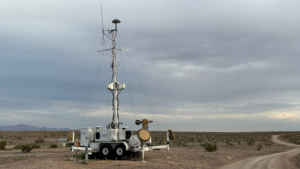
On July 13, ACI International Inc. announced a contract to deploy CACI’s SkyValor, transportable drone defense system, at the U.S. Southern Border. Under the contract, CACI will deliver SkyValor as a maneuverable drone defense system that can be setup rapidly.
The system will be deployed to strategic locations as part of a larger national security effort led by the U.S. JIATF-401. SkyValor also recently completed a round of testing and demonstrations at Marine Corps Air Station Yuma.
CACI received the first task order under a three year, $500 million indefinite delivery/indefinite quantity contract. The company also announced that recent completion of operational evaluations has enabled SkyValor to enter full rate production.
On July 14, Lockheed Martin announced a U.S. Department of Defense contract award to develop the Joint Laser Weapon System (JLWS) program. Designed to counter UAS and cruise missiles, the containerized 500 kW laser weapon system is being developed to provide a cost-effective solution to the airborne threats.
Separately, the U.S. Department of Defense announced it has awarded $86 million in agreements for the JLWS program.
At the Farnborough Airshow on July 20, Lockheed Martin unveiled its MORFIUS X-Rotor, a ground-launched, airborne high-power microwave system capable of neutralizing over 50 hostile drones during a single engagement. According to the company, MORFIUS X-Rotar is built around a field-recoverable frame, which allows the platform to return to base after deployment for reuse and a reduced cost per kill compared to traditional missile interceptors.
Surveys and Sources Sought
Wrapping up July’s notable moves, the U.S. Army issued a market survey to identify potential industry sources capable of delivering existing or conceptual architecture that integrates a 50mm weapon-based C-UAS employing 50x228mm rounds, to track, engage, and defeat Class 1, Class 2, and Class 3 UAS threats.
Along somewhat similar lines, the U.S. Air Force issued an RFI to evaluate market capabilities for a durable C-UAS device. The Sources Sought announcement aims to assess potential contractors capable of providing either a portable or stationary C-UAS platform designed to detect and defeat commercial off-the-shelf drones. The Air Force further emphasized that the notice is strictly for planning and information-gathering purposes.
Later, on August 6, the U.S. Army’s C-UAS Product Office issued a Sources Sought Notice for the Next Generation C-UAS Missile (NGCM), seeking industry input to develop an interceptor to defeat Group 2 and Group 3 small, UAS threats. In an effort to improve launch response times and range over current capabilities, the missile must be capable of leaving the launch rail in under five seconds and is also required to support both Fixed-Site Low, slow, small UAS Integrated Defeat System (FS-LIDS) and Mobile (M-LIDS) configurations.
Later that month, on August 19, ThinKom Solutions announced an Other Transaction prototype project award from the U.S. Army to deliver and evaluate a mobile high-power microwave C-UAS capability. The company will provide its Alecto HPM effector, integrated with government-designated sensors, fire-control capabilities and a mobile platform.
The agreement has a ceiling of $49 million, with initial funding for one of four prototypes and field testing in 2027.
In light of spreading conflicts in the Middle East, Europe and other hotspots worldwide, there are few signs of C-UAS investment slowing down anytime soon, and coming months are likely to be just as interesting as this rapidly ending Summer.

Andrew Dardine is lead analyst for Forecast International's Defense Electronic Systems group. He is the primary author of Forecast International's Electronic Warfare Forecast and co-author of Electro-Optical Systems Forecast and C4I Forecast. Andrew is also a regular contributor to FI's Defense & Security Monitor blog, offering insights into developing technologies such as directed-energy and next-generation jamming systems. His analysis of such vital market areas as EO/IR systems and electronic countermeasures technology has been cited in Defense News, Aerospace Daily, and Bloomberg Businessweek, among other news media. He has also written about the electronic defense market for Aviation Week and the Journal of Electronic Defense.