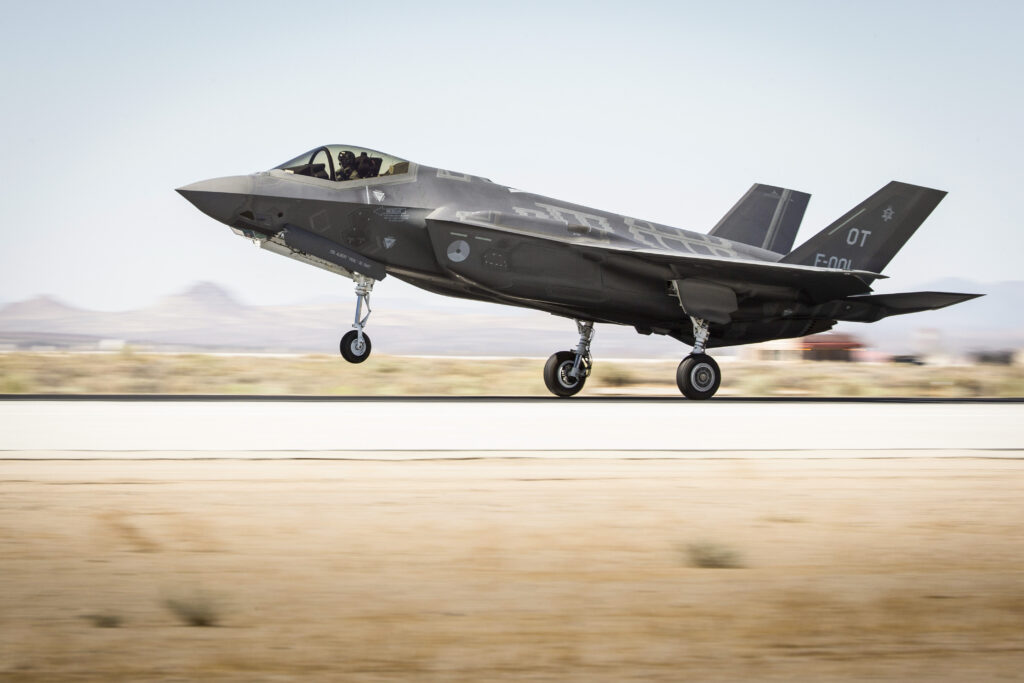
The United States approved a possible Foreign Military Sale of F-35 fighter jets to Saudi Arabia on September 17, a major development that would make the Royal Saudi Air Force (RSAF) the second operator of the type in the Middle East and the first Arab operator to fly a fifth-generation combat aircraft.
In a press release, the U.S. State Department said Riyadh requested to purchase 48 F-35 Lightning II fighter jets, which together with engines and other onboard equipment will cost around $24.3 billion. The RSAF will use the aircraft to strengthen homeland defense and deepen interoperability with the U.S., the State Department noted, adding that the jets will additionally “enhance its air-to-air, and air-to-ground self-defense capability.”
The F-35 approval followed a separate green light announced on September 4 for Saudi Arabia to acquire over 10,000 general purpose bombs and as many Joint Direct Attack Munition tail kits. That munitions sale carries a price tag of $5 billion.
Saudi Arabia’s Interest in the F-35
Saudi Arabia has long coveted the fifth-generation fighter jet, which has proven its combat utility flying missions in the Middle East. The jet’s stealth features make it difficult to detect with radar, enabling the F-35 to effectively perform suppression of enemy air defense and air-to-air missions while being less susceptible to incoming fire than its fourth-generation counterparts.
Israel, the only local operator of the F-35 in the region, began using it in operations over Syria in 2018. Israeli F-35s saw combat duty against Iran on two occasions in 2024, and then again during a brief conflict between the two in summer 2025. As part of their joint Operation Epic Fury/Lion’s Roar, launched in early 2026, both the U.S. and Israel heavily leaned on the platform to conduct strikes on Iran, hitting Iranian air defenses and high-value targets. Early on in that war, an Israeli F-35I achieved the type’s first air-to-air kill on a manned fighter, shooting down an Iranian Air Force Yak-130.
Despite Iran owning a sizable arsenal of air-defense systems, no F-35s have been shot down to date. Iran did manage, however, to successfully target an American F-35 during U.S. operations in mid-March. That aircraft was forced to make an emergency landing after sustaining incoming fire.
The successful operational track record makes the F-35 an appealing asset for Saudi Arabia, whose Air Force has performed an air campaign over Yemen since early 2015. The RSAF has lost aircraft on numerous occasions to anti-aircraft fire over Yemen, including an F-15 claimed to have been shot down this past month. The F-35 would also help Saudi Arabia improve its deterrence against Iran directly.
As the Middle East’s largest defense spender, with a budget of $64.4 billion in FY26, Riyadh has plenty of funding to absorb the procurement and operational costs of the jet.
Potential Challenges to the Sale
While FMS approvals enable the two sides to move forward with contract negotiations, not all approvals will lead to procurement agreements. During the active phase of Operation Epic Fury, the State Department approved a number of arms agreements to the Gulf countries with emergency waivers that circumvented the requirement of Congressional review. No such waiver was granted in this sale, so the U.S. Congress will have 30 days to review the deal and technically could block it. Doing so would require a veto-proof majority that is unlikely to be found given the composition of the two chambers, however, and it is exceedingly rare for Congress to block an arms deal.
More significantly, there are foreign policy considerations at play that could complicate F-35 negotiations, particularly given the sensitivity of the technology powering the F-35. The U.S. is keenly concerned about potential technology leakage to China and thus imposes strict safeguards on F-35 exports to minimize the risk that a leak might occur.
A comparison can be drawn with the failed Emirati bid for the F-35. In November 2020, during the last few months of the first Trump administration, Washington approved a $10.4 billion sale of 50 F-35As to the United Arab Emirates. That approval, however, never led to a firm contract, and the UAE later suspended contract negotiations with the Biden administration over what the Emirati Ministry of Foreign Affairs described as ‘sovereign restrictions’ and ‘technical requirements’.
The UAE’s close relationship with Beijing likely played a role in felling its F-35 aspirations and a similar story could play out with Riyadh’s own procurement of the jet. China is Saudi Arabia’s biggest trade partner, and the Kingdom has some measure of defense cooperation with the Chinese government, importing drone and missile systems.
There is also a question of the impact on Israel’s ‘qualitative military edge’, which the U.S. is committed to preserving. Israel is the only operator of the F-35 in the Middle East, having signed several contracts totaling 75 units. The Israeli government has staunchly objected to Saudi Arabia receiving the jet, over concerns that it would diminish Israeli air superiority over its neighbors.
Washington has traditionally tied Saudi political normalization with Israel to any potential sale of the F-35. Ahead of its own F-35 approval, the UAE joined the ‘Abraham Accords’ and recognized Israeli sovereignty. Saudi Arabia has not taken such a step to date, instead pushing first for an “irreversible pathway” to a Palestinian state as a precondition to any normalization with Israel. It is not apparent whether the U.S. is still pushing normalization as a requirement for signing the F-35 contract with Saudi Arabia.
Saudi Arabia will additionally request some form of local involvement for its defense industry, in line with its ‘Vision 2030’ industrialization initiative. For the RSAF’s F-15 purchase, Saudi Arabia was able to secure production of the jets’ wings. It is unknown how much the U.S. would agree to in regards to the F-35, though Riyadh would likely not jeopardize a purchase agreement for such a significant platform by pushing too hard for defense industrial involvement.
Kingdom Under Fire
Should the F-35 deal ultimately move forward into a contract, it will be a number of years before the RSAF will actually receive and operate the jets. The announcement of the sale’s approval nevertheless comes at a sensitive time for the Kingdom, as it faces a multifaceted security crisis involving Iran and various Iranian-backed militias throughout the Middle East region.
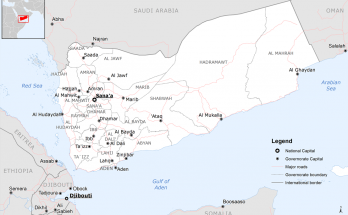
In the wake of the U.S.-Israeli conflict with Iran, Saudi Arabia came under Iranian missile and drone attacks. Its energy exports have moreover been disrupted amid Iranian action in the Strait of Hormuz, which has caused tanker volume through the strategic waterway to fall well below pre-war levels. Another wrinkle developed in late July, as the Yemeni rebel group Ansar Allah, commonly referred to as the Houthis, announced the closure of the Bab el-Mandeb Strait, through which Saudi Arabia has been rerouting its oil exports. Earlier this month, the Iranian-backed militants made good on the threats, launching a new offensive down Yemen’s southwestern coast that recaptured the port city of Mokha as well as nearby islands in the Red Sea.
Iranian-supported militias in Iraq, meanwhile, carried out strikes on Saudi Arabia’s East-West pipeline on September 10, which connects to terminals on the Red Sea, resulting in a shut down of the pipeline’s operations.
Already by August, before some of these latest developments, Saudi oil exports had fallen to 3.2 million barrels per day, the lowest level since 2013. Economic growth contracted 4.7 percent in the second quarter of 2026.
Direct help from Saudi allies and partners has not been immediately forthcoming. The U.S. has reportedly declined Saudi requests for military action against Ansar Allah, instead negotiating with the group to preserve a 2025 ceasefire. Saudi Arabia inked a trilateral defense accord with Pakistan and Turkey in August – which supposedly has ‘Article V’-like mutual defense assurances – but neither Islamabad nor Ankara has been in much of a hurry so far to involve themselves in Yemen.
Riyadh may thus be feeling a sense of isolation as it grapples with the situation south of its borders and the crisis facing its oil exports. Receiving approval for the F-35 therefore stands as a significant political signal out of Washington of its long-term defense relationship with the Kingdom.

Military markets analyst, covering Eurasia, Middle East, and Africa.