The longest government shutdown in history has finally ended, but what does that mean for the Pentagon’s FY26 budget?
It took well over a month for lawmakers to resolve the lapse in appropriations. In September, the House passed a short-term CR that would have kept the government running at FY25 levels through November 21, but the Senate rejected it multiple times over disagreements about healthcare subsidies set to expire. With the shutdown stretching into its second month, eight Democrats broke ranks to support an agreement with GOP leadership to reopen the government until January 30 in exchange for a Senate vote on healthcare subsidies in December. The deal also provides back pay for furloughed federal workers. The legislation includes three appropriations bills, providing FY26 appropriations for the Legislative Branch, Military Construction, Veterans Affairs, Agriculture, Rural Development, and the Food and Drug Administration. The Senate passed the bill on Monday by a vote of 60 to 40, and the House voted 222 to 209 on Wednesday to approve the bill. The president signed the legislation later that evening, finally ending a record-setting 43-day shutdown.
The shutdown had a significant impact on the Pentagon. While the military is accustomed to operating without a final budget at the start of the fiscal year, there is typically a continuing resolution (CR) in place that funds the government at the previous year’s levels until new appropriations are passed. This time, however, there was no CR to keep the government running. As a result, hundreds of thousands of DoD civilians were furloughed, and the Pentagon diverted unspent money from shipbuilding and research accounts to cover troop pay, including funds from the reconciliation bill passed over the summer. A lack of funding also began to impact contract awards, resulting in potential delays for critical acquisition programs.
The Defense Budget Process
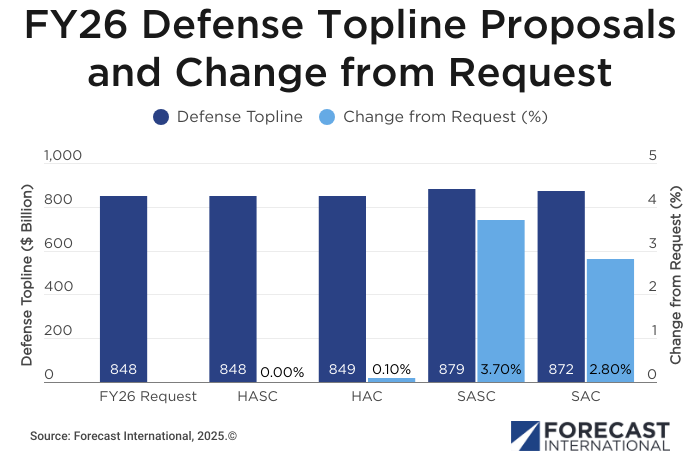
To fully understand the next steps for the Pentagon, it’s important to know the basics of the defense budget process. There are two parallel tracks related to the defense budget. The House and Senate Armed Services Committees (HASC and SASC) are responsible for crafting the National Defense Authorization Act (NDAA), while the House and Senate Appropriations Committees (HAC and SAC) handle the defense appropriations bill. The NDAA is a piece of legislation that impacts defense policy, but it’s the appropriations bill that ultimately determines the Pentagon’s final budget each year.
All four committees have released their FY26 proposals, each reflecting a version of the president’s budget request submitted earlier this year. The impact of those proposals is outlined in Forecast International’s FY26 U.S. Defense Budget Spotlight, which tracks the defense budget throughout the congressional markup process. Those proposals must be reconciled to produce final versions of the NDAA and defense appropriations bill, which will be reflected in the dashboard if and when they materialize.
Notably, the dashboard includes estimated reconciliation funding applied to FY26 programs. The FY26 request included $113.3 billion in reconciliation funds, primarily for procurement ($51.9 billion) and RDT&E, or research, development, test, and evaluation ($37.1 billion). Interestingly, the administration removed $25 billion worth of acquisition funding from the FY26 base budget, offsetting the shortfall through the reconciliation bill.
What Happens Next?
The Pentagon could potentially find itself with billions of dollars in additional funding for new equipment in FY26 — if Congress is able to pass a budget. Both Senate defense committees proposed significant topline increases that would add about $18 billion for procurement in FY26. Conversely, the HASC and HAC markups are in line with the president’s request. However, because the House appropriations bill was drafted before the FY26 request was released, it doesn’t reflect the administration’s $25 billion reconciliation transfer. As a result, the HAC version ultimately includes $21 billion more for procurement in the base budget than the administration requested. There is also a divide when it comes to research and development. The SAC outlined a modest reduction for research, while the HAC and SASC bill proposed increases of 3.2 percent and 4.7 percent, respectively.
Overall, these markup trends suggest a final appropriations bill would boost shipbuilding, Air Force aircraft, and Navy weapons funding, according to the FY26 U.S. Defense Budget Spotlight dashboard. There are notable differences as well, which will have to be sorted out during conference negotiations. For example, the SAC proposed large plus-ups for Army and Air Force missile accounts absent from the HAC bill. Conversely, the Senate appropriations bill would slash Navy aircraft funding by 8.1 percent, compared to a 5.6 percent increase in the House version. The HAC proposal also reduces funding for Army ammunition and the service’s ‘Other Procurement’ account, which covers electronics, tactical vehicles, and miscellaneous programs.
What if Congress Can’t Pass a Budget?
Ending the shutdown doesn’t guarantee passage of an FY26 defense budget. Under the new agreement, lawmakers will have by the end of January either to pass FY26 appropriations bills or approve another stopgap CR. Failure to do so could trigger another government shutdown, which is not out of the question since the agreement doesn’t resolve the healthcare subsidy debate that triggered the shutdown in the first place.
A full-year CR, like the one used in FY25, also remains on the table. Typically, a full-year CR is a worst-case scenario for the Pentagon, but the impact would be blunted this time around. CRs lock in spending levels from the previous year, which means you lose any planned budget growth outlined in a new budget request. However, the Pentagon’s FY26 base budget request was flat compared to FY25, meaning topline funding would remain unchanged by a full-year CR (though account-level and program-level funding amounts would be misaligned). Lawmakers would also likely provide increased funding transfer limits and flexibility to launch new programs, as they did for FY25. The Pentagon would also retain access to reconciliation funding, which accounts for the entirety of planned growth in FY26.
However, there are still downsides. For one, a full-year CR would erase the Senate’s proposed defense increases for FY26, mirroring the outcome of the FY25 budget process. The military would also have to navigate the bureaucracy of shifting billions of dollars in misaligned funds to ensure programs have adequate resources, even with increased funding transfer authority. So, while the government has finally opened its doors, the FY26 budget process is far from over.
Sign up for the free FY26 U.S. Defense Budget Spotlight to stay apprised of the FY26 defense budget process.
More Defense Budget Data
Forecast International’s U.S. Defense Budget Forecast makes it easy to navigate the latest U.S. defense budget. The product features sorting and data visualization options and presents the entire Future Years Defense Program (FYDP) for acquisition programs through an online interface with downloadable spreadsheets. This is the go-to service for anyone looking to save time and energy in navigating the massive Department of Defense budget.

Shaun's deep-rooted interest in military equipment continues in his role as a senior defense analyst with a focus on the United States. He played an integral role in the development of Forecast International's U.S. Defense Budget Forecast, an interactive online product that tracks Pentagon acquisition programs throughout the congressional budget process. As editor of International Military Markets – North America, Shaun has cultivated a deep understanding of the vast defense markets in the United States and Canada. He is a regular contributor to Forecast International's Defense & Security Monitor blog and has co-authored white papers on global defense spending and various military programs.