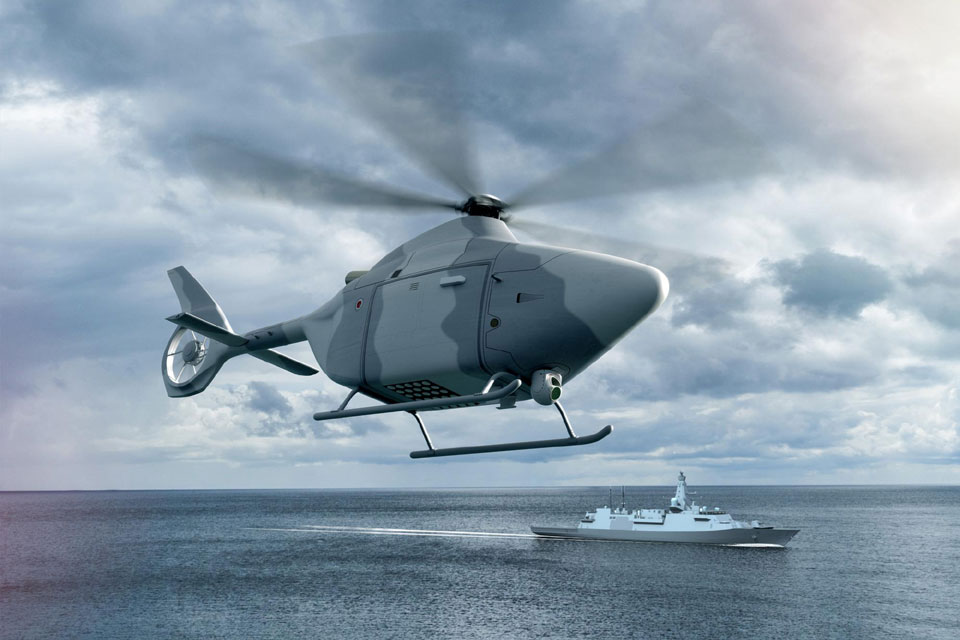
 Source: Leonardo
The British Army is moving toward a new model of manned and uncrewed aerial operations as the Ministry of Defence advances Project NYX, a program aimed at pairing the AH-64E Apache attack helicopter with a highly autonomous uncrewed aircraft for frontline missions.
The initiative reflects a shift toward what the Army describes as a “command, not control” approach, in which crews issue mission objectives rather than directly piloting accompanying uncrewed systems. The goal is to reduce risk to human pilots while extending the reach and survivability of crewed aircraft in contested environments.
Following a selection process that concluded in late January 2026, the Ministry of Defence has invited seven companies to develop concepts for the Land Autonomous Collaborative Platform, an uncrewed system designed to operate alongside the Apache. The invited firms are BAE Systems, Leonardo, Lockheed Martin UK, Thales, Anduril UK in partnership with GKN Aerospace and Archer Aviation, Tekever, and Syos Aerospace.
The group combines established defense primes with smaller and newer entrants focused on autonomous and uncrewed technologies. Several competitors are expected to emphasize software-driven autonomy and electronic warfare integration, while others are proposing novel air vehicle designs, including vertical take-off and landing and tilt-rotor concepts.
Project NYX places priority on high levels of autonomy rather than remote piloting. Under current requirements, Apache crews would assign mission-level tasks such as reconnaissance, target identification, or strike, with the uncrewed platform responsible for navigating terrain and responding to threats independently. The Ministry of Defence has indicated that candidate systems should be capable of carrying payloads exceeding 250 kilograms while achieving performance broadly comparable to the Apache, including speeds of around 150 knots and a range of approximately 270 nautical miles.
The program’s timeline is compressed. By March 2026, the field is expected to be reduced to four finalists that will receive research and development contracts to produce demonstrator aircraft. These systems are scheduled to undergo flight testing during 2027 and 2028. If development milestones are met, the Army aims to introduce the first operational uncrewed companions into frontline aviation units around 2030.
The outcome of Project NYX will shape how the British Army adapts to the growing role of autonomy in warfare. By integrating uncrewed systems capable of independent action with existing attack helicopters, the UK is seeking to enhance combat effectiveness while managing risk and cost in an increasingly contested and technology-driven battlespace.

A military history enthusiast, Richard began his career at Forecast International as editor of the World Weapons Weekly newsletter. As the Internet became central to defense research, he helped design the company’s Forecast Intelligence Center and now coordinates the FI Market Recap newsletters for clients. He also manages two blogs: Defense & Security Monitor, which covers defense systems and international security issues, and Flight Plan, focused on commercial aviation and space systems.
For more than 30 years, Richard has authored Defense & Aerospace Companies, Volume I (North America) and Volume II (International), providing detailed data on major aerospace and defense contractors. He also edits the International Contractors service, a database tracking all companies involved in programs covered by the FI library. Richard currently serves as Manager of the Information Services Group (ISG), which develops outbound content for both Forecast International and Military Periscope.
image sources
- Proteus-flying-over-sea_960640: Leonardo