 Source: Canadian Armed Forces
The Canadian government has released its first-ever Defense Industrial Strategy, a comprehensive initiative aimed at expanding the domestic industrial base, increasing the share of defense acquisition contracts awarded to Canadian firms, and growing arms exports.
Announced by Prime Minister Mark Carney last week, the strategy is designed to modernize the Canadian Armed Forces while increasing its reliance on domestic industry. The new initiative aims to eventually award 70 percent of all defense acquisition contracts to domestic companies, up from around 43 percent. This pivot comes at a time when Ottawa says it will meet its initial NATO commitment to spend 2 percent of GDP on defense ahead of schedule in fiscal year 2025/26 and plans to meet the alliance’s revised 5 percent benchmark by 2035. The government has outlined CAD 180 billion in planned procurement opportunities and CAD 290 billion in defense-related capital investment over the next 10 years.
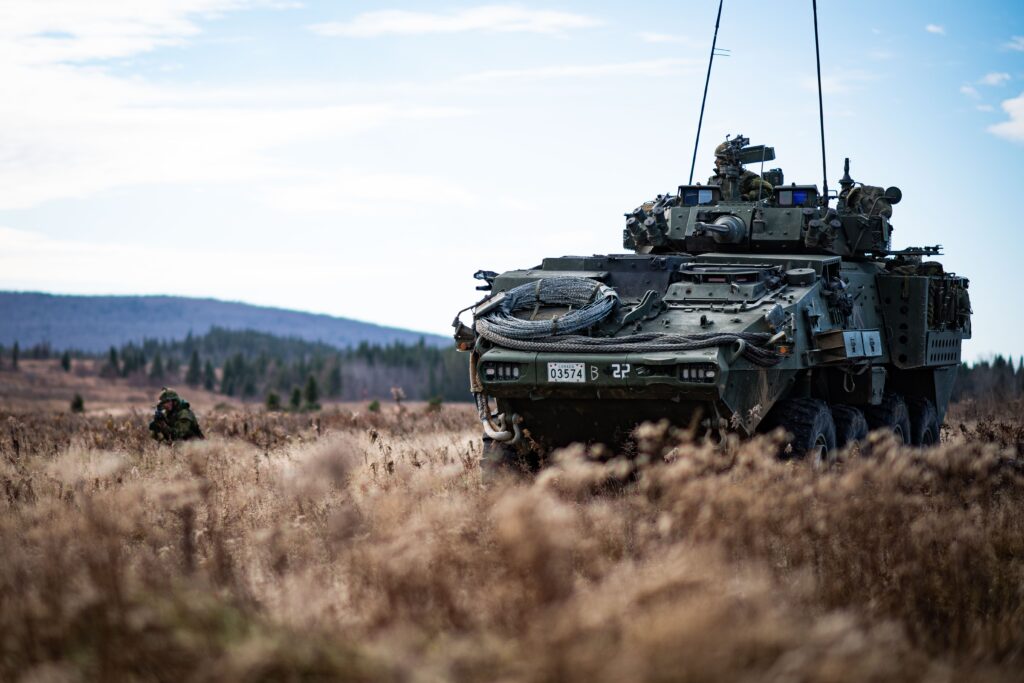
To manage this influx of defense spending, the strategy introduces a “Build-Partner-Buy” procurement framework that mandates prioritizing domestic acquisition in areas such as aerospace, combat vehicles, munitions, and shipbuilding. Where production capacity is not immediately available, the strategy calls for the government to partner with “like-minded allies” to attract foreign investment in Canadian industry and encourage technology transfer and supply chain agreements that could facilitate additional domestic production efforts. Only after all those options are exhausted will Ottawa procure equipment from foreign suppliers.
The overhaul will be managed by a newly established Defense Investment Agency (DIA), which is tasked with streamlining military acquisitions and expanding domestic production. Furthermore, the government promises to increase investment in military research and development by 85 percent to support next-generation capabilities, such as artificial intelligence, robotics, autonomous systems, and quantum technologies. This investment will be supported by a new Bureau of Research, Engineering and Advanced Leadership (BOREALIS) to coordinate research in emerging fields.
Carney recognized Canada’s prolonged underinvestment in defense and domestic infrastructure. “And we have relied too heavily on our geography and other countries to protect us,” the prime minister said. “This has created vulnerabilities we can no longer afford and dependencies we can no longer sustain.” While he did not mention the United States by name, his comments reflect the deteriorating relationship between Canada and the U.S. that has caused Ottawa to look both domestically and increasingly toward Europe for procuring new defense capabilities. However, Canadian and American defense industrial bases are deeply intertwined, and several major American defense companies have Canadian subsidiaries, meaning procurement of certain U.S. systems directly benefits Canadian industry. It remains to be seen to what extent Ottawa will distance itself from buying U.S. equipment, particularly as Washington takes steps to increase its own defense exports. Nevertheless, future Canadian acquisition programs can be expected to weigh domestic economic and manufacturing benefits more heavily than they have in the past, facilitating expansion of Canada’s defense industrial base.

Shaun's deep-rooted interest in military equipment continues in his role as a senior defense analyst with a focus on the United States. He played an integral role in the development of Forecast International's U.S. Defense Budget Forecast, an interactive online product that tracks Pentagon acquisition programs throughout the congressional budget process. As editor of International Military Markets – North America, Shaun has cultivated a deep understanding of the vast defense markets in the United States and Canada. He is a regular contributor to Forecast International's Defense & Security Monitor blog and has co-authored white papers on global defense spending and various military programs.
image sources
- EX LION INTRÉPIDE: Canadian Armed Forces