Throughout this past year, Dassault and Airbus have been locked in an increasingly public battle over the direction of the Future Combat Air System (FCAS), a program to deliver a next-generation fighter jet to the French and German Air Forces. Despite efforts by the French and German governments to address the divide between the two FCAS partner companies, the program may be headed for a break-up in 2026.
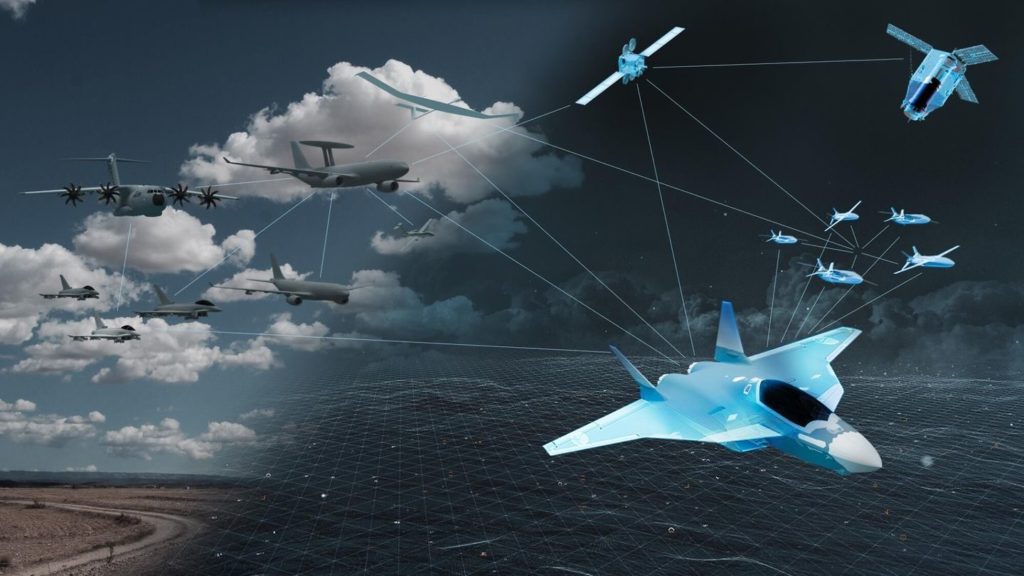
FCAS was launched in 2017 to deliver a series of new military capabilities to France and Germany, with a principal focus on the creation of a sixth-generation fighter jet to replace the fourth-generation jets presently in their arsenals. The jet was expected to be developed through the 2030s and enter operational duty between 2040 and 2045. Once operational, the fighter jet was envisioned to operate alongside a ‘remote carrier’, built by Airbus and MBDA, that would act as a loyal wingman for its manned counterpart. These systems would be networked with other assets through a joint combat cloud, also to be developed under the FCAS banner.
Besides Berlin and Paris, FCAS also counts Spain as a full member and Belgium as an observer.
France and Germany awarded Dassault and Airbus a Phase 1A contract in February 2020 to officially kick-off the demonstrator phase of the FCAS program with a goal of getting a prototype jet flying with a new engine as early as 2026. FCAS moved to Phase 1B in March 2023 and has been expected to reach Phase 2 – wherein the demonstrator will actually be built – no later than the mid-2026.
Throughout development, however, Dassault and Airbus have clashed over workshare and intellectual property in the program, leading to delays that have pushed the fighter jet’s maiden flight to the end of the decade at the earliest. Those issues were intended to be smoothed out with an industrial agreement announced in December 2022. But friction has persisted between the two partners, escalating throughout this year to a point that threatens the future of the program itself.
In an April 2025 hearing before the French National Assembly, Dassault CEO Eric Trappier sounded a warning note, stating, “Something is not working. So it needs to be reviewed. It’s not up to me to do that, it’s up to the states to get together to figure out how to better manage this ambitious program.”
Tension escalated throughout the summer months of 2025, as press reports began emerging that Dassault was seeking up to 80 percent workshare in the fighter jet’s development. The German Ministry of Defense warned in a letter to parliament that conceding that much of the program to France would have significant consequences for Germany’s industry.
Despite interventions from the two governments over the past few months, the two sides remain at odds and are increasingly contemplating a break-up on fighter jet cooperation. In November, French and German officials told the Financial Times that talks were exploring canceling the fighter jet pillar while retaining some of the other FCAS pillars. Airbus is the lead partner on both the joint combat cloud and the remote carrier projects, both of which could still proceed independently even in absence of a fighter jet.
Should fighter jet cooperation end, both the German and French militaries will need to scramble for alternative plans. Berlin is already taking a step to introduce a fifth-generation fighting capability into its combat air fleet, purchasing 35 F-35 fighter jets in 2022. Production of the first F-35 began last month and numerous media outlets have reported throughout 2025 (despite Ministry of Defense denials) that Germany is seriously considering tacking on another 15 jets to the order.
But developing an entirely new next-generation fighter would be a challenge for German industry. Rather than lean on Airbus for an entirely new jet, the government would probably be forced instead to join on to the other major fighter jet program on the continent, the Global Combat Air Program (GCAP), which brings together the United Kingdom, Italy, and Japan. Italian Defense Minister Guido Crosetto told parliament earlier in December that Berlin “could probably join this project in the future,” should a request be made.
Joining GCAP at this stage, however, would certainly entail German concessions on industrial participation, the same fate Germany has been hoping to avoid with FCAS. GCAP partners BAE Systems, Leonardo, and JAIEC already concluded an agreement last December on the joint venture to design and produce the GCAP fighter jet, to be owned in equal portions by the three companies. The GCAP countries would certainly welcome German orders for the program’s eventual fighter jet product, but that that doesn’t necessarily mean they will invite German industry to join them in development.
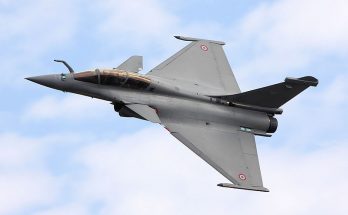
France’s path forward from the FCAS saga is also murky, though for different reasons than with Germany. Dassault encountered a similar fork in the road with the development of the fourth-generation Eurofighter Typhoon, leading the company to go it alone on the creation of the Rafale. Dassault delivered its 300th Rafale in October 2025 and has a back-log of over 200 more, demonstrating the company’s technical capacity to build a new jet from scratch should it need to.
While France’s industry is technically capable of designing and producing a new-generation fighter jet on its own, without Berlin it would be doing so in a significantly different financial environment. FCAS carries an estimated cost floor of €100 billion, a third of which is to be shouldered by Germany. With FCAS Phase 2 soon to begin, funding for the program will start growing significantly in the coming years.
In its upcoming budget, France plans to devote €36.6 billion – 64 percent – towards equipment acquisition and maintenance. Spain allocates over €7 billion annually towards the same purpose. These are not small sums but must be spread across a wide range of priorities, including managing a nuclear deterrent in France’s case, leaving little wiggle room to make up for the cost-sharing Berlin was expected to provide.
France moreover faces a tight budget picture that has put a damper on defense spending growth. The French budget is running annual deficits exceeding 5 percent of GDP and gross debt stands at over 116 percent of annual economic output, putting it well in excess of E.U. fiscal rules on both items. The E.U. would like Paris to correct the deficit issue by 2029 and that has proven to be tricky enough for successive French governments which, lacking majority support in the parliament, have repeatedly fallen victim to confidence votes in wake of budget austerity proposals.
It is hard to expect significant growth in French defense spending in this context, meaning the topline budget is likely to remain stuck at around 2 percent of GDP. Berlin, long also a defense spending laggard, has by contrast cleared the way for defense budget growth and is now setting an ambitious goal of 3.5 percent of GDP by 2029.
There are thus strong reasons for both Germany and France to want to save FCAS, and publicly Paris (along with Madrid) has remained confident that the program proceeds. Yet that seems “very unlikely” sources told Reuters after a trilateral meeting of defense ministers on December 16. Trappier similarly cast doubt on the program’s future on the same day at a conference.
As 2026 approaches, the project once intended to be the centerpiece of French and German defense is increasingly at risk of splitting apart or being abandoned altogether.

Military markets analyst, covering Eurasia, Middle East, and Africa.