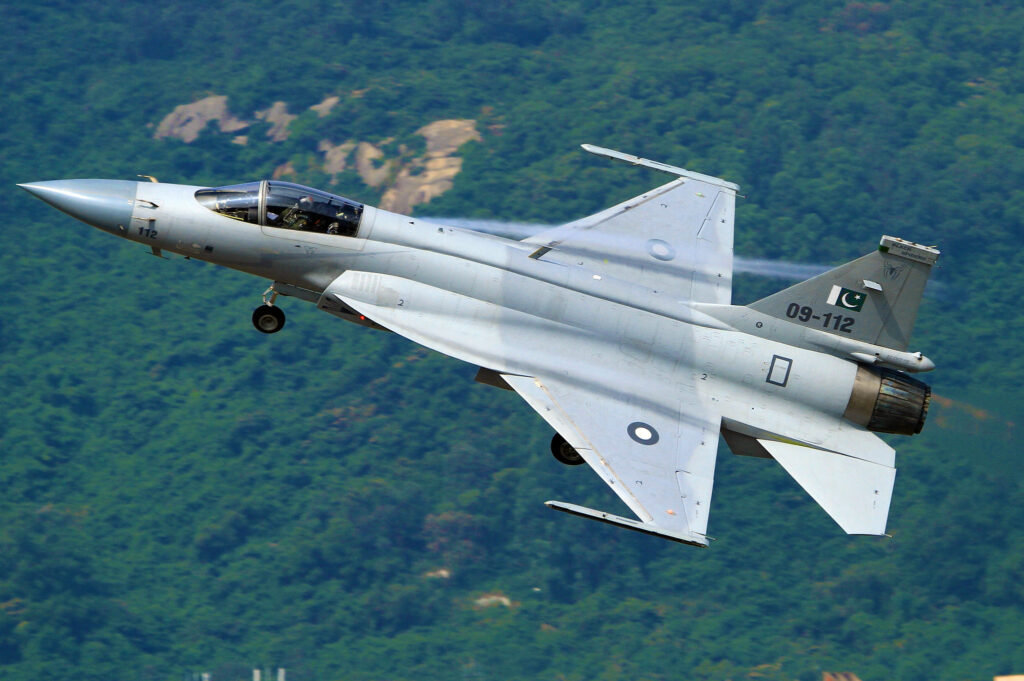
Throughout the month of December and into January, Reuters and other news sources dropped a steady drum-beat of news on potential Pakistani arms export deals, most of which center around the JF-17, a fighter jet developed and produced in partnership with China. Many of these potential buyers are also browsing competitor platforms, meaning that some of these deals reported in the press over the last two months won’t come to fruition. The Pakistani government is nevertheless plainly embarking on an aggressive sales push for its defense equipment.
On December 22, Pakistani government sources told Reuters that a $4 billion deal was in the works to sell a dozen JF-17 fighter jets and 16 Super Mushshak trainer aircraft to the Libyan National Army (LNA), one half of Libya’s ongoing civil war. Then on January 7, the Pakistani military announced JF-17 negotiations with Bangladesh, followed a day later by a Reuters report discussing similar talks with Saudi Arabia that could see the Kingdom spend $4 billion – half of which would be debt forgiveness – for the JF-17. On January 9, Reuters revealed that Pakistani officials have also recently negotiated with the Sudanese Armed Forces (SAF) over a $1.5 billion arms deal that could be expanded to include the JF-17.
Finally, on January 12, officials told Reuters that Pakistan held talks with Indonesia for more than 40 JF-17s, as well as Shahpar UAVs.
For Islamabad, drumming up foreign sales helps boost the image of Pakistan’s defense industry while driving in revenue that the government needs. In terms of raw capabilities, the JF-17 will be exceeded by other combat aircraft on the market. Where Islamabad hopes for an edge, however, is in offering a quality jet at a reasonable price, with the prospect of licensed-assembly or even technology transfer.
“Our aircraft have been tested, and we are receiving so many orders that Pakistan may not need the International Monetary Fund in six months,” Defense Minister Khawaja Asif bragged in an interview with GeoTV.
Both the reported sale to Libya and negotiations with Sudan could run afoul of international pressure, and both likely hinge on foreign financing supporting the procurement. Libya is under an international arms embargo, meaning that any sale to either the LNA or rival Government of National Unity requires blessing from the U.N. Security Council. It is also an open question where the LNA might find the funding to splash on new equipment and training, though the faction’s close ties to the United Arab Emirates (UAE) might enable its commander, Gen. Khalifa Haftar, to strike an agreement for Emirati financing.
International arms embargoes on Sudan are less comprehensive than those on Libya, yet the country similarly faces a destructive civil war that limits its available funding for procurement. Sudan’s economy entered freefall in 2023, as the country erupted into civil war between the SAF and the Rapid Support Forces. The government, only now re-establishing itself in the capital Khartoum, has been running large budget deficits to support the war effort, and the central bank is only sitting on reserves of around $1.6 billion.
The SAF would plainly need help to sign contracts for military procurement of any consequence. So whereas the UAE might be a source of funding for Haftar’s forces in Libya, Saudi Arabia could play a similar role for the SAF in Sudan – and that may provide context for the reports of Riyadh negotiating for the JF-17.
The Kingdom of Saudi Arabia is the Middle East region’s largest defense spender, devoting around $64 billion to defense in its FY26 budget, and as such can afford virtually any piece of military equipment available on international markets, including combat aircraft that far exceed the JF-17’s capabilities. Riyadh is said to especially covet the F-35, which to date has only been sold in the Middle East to Israel.
As pointed out in an analysis published at TWZ, Riyadh could jeopardize its aspirations for the F-35 should it acquire the JF-17, given China’s fingerprints on the jet and the likelihood of deeper ties with China as a result of such a purchase. By way of comparison, the UAE was approved to enter formal purchase negotiations for the F-35 in 2021, but that deal fell apart later the same year amid concerns about an increasingly-cozy relationship between Abu Dhabi and Beijing.
There is logic from an industrial point of view for Saudi Arabia to be interested in the JF-17, as Riyadh could plausibly negotiate technology transfer or licensed-assembly. And shoring up the security of Pakistan is its own benefit for Saudi Arabia, particularly after the two signed a mutual defense pact in September. But the JF-17 would not move the Royal Saudi Air Force’s military capabilities forward, particularly if it cost Riyadh access to the F-35, and so that may weigh on Riyadh’s overall intentions for introducing the fighter jet into its own inventory.
Besides the negotiations in the Middle East and North Africa, Pakistan is also said to be in talks with Bangladesh and Indonesia for the JF-17. Dhaka is in the process of evaluating a purchase of as many as two dozen fighter jets. In December, the Bangladesh Air Force inked a letter of intent for the Eurofighter Typhoon which, while non-binding, demonstrates strong preference for the jet. Bangladesh is also said to be considering a purchase of the J-10C either alongside or in lieu of the Typhoon.
Indonesia, meanwhile, has been on a fighter jet buying spree. In February 2022, Jakarta signed an $8.1 billion deal with France to acquire 42 Dassault Rafale fighter jets, the first of which are set to arrive in the coming months. This past July, Indonesia concluded an “implementation contract” with Turkey that could see the Indonesian Air Force purchase up to 48 KAAN combat aircraft once those are ready for production. That was followed in October 2025 by a comment from Defense Minister Sjafrie Sjamsoeddin that Indonesia is also working on a purchase of 42 J-10Cs. Officials have also suggested the moribund Su-35 deal, felled by the threat of U.S. sanctions, may still be pursued in the future.
To date, Pakistan has sold a few dozen JF-17s to three countries (Nigeria, Myanmar, and more recently Azerbaijan) and supplied over 150 to its own Air Force, for a production run of around 200 units. According to Reuters’ sources, Pakistan is currently in talks to sell military equipment, especially though not limited to JF-17s, to another 13 countries, with around half of those negotiations at an advanced stage.
Many of these talks may not translate into firm sale agreements, either for political, cost, or technical reasons. Islamabad’s aggressive advertising nevertheless demonstrates the country’s rising importance to global defense markets, making the country a viable alternative supplier for countries throughout Africa and Asia.

Military markets analyst, covering Eurasia, Middle East, and Africa.