Following the “12-Day War” with Israel in June 2025, the Iranian government accelerated negotiations with Russia and China to procure advanced missile systems. According to recent reports from the Financial Times and Reuters, these talks persisted even after the international arms embargo was reinstated in September.
Iran was barred from the legal arms trade for years, as part of a concerted international effort to force the country to negotiate over its nuclear program. In 2015, the five permanent members of the Security Council plus Germany struck a nuclear accord with Iran that would, among other provisions, sunset the arms embargo after a period of eight years. As the embargo lapsed in October 2023, Iran moved quickly to sign arms agreements, ordering Russian combat aircraft and ballistic missile precursors from China.
The nuclear issue, however, has been far from settled, particularly with Washington’s abrupt exit from the accord in 2018 under the first Trump administration. And with Donald Trump back in the White House, the U.S. launched a new round of dialogue with Iran throughout the first half of 2025. These talks produced little in terms of concrete outcomes. On June 12, 2025, the IAEA declared Iran in violation of its nuclear commitments. Israel launched Operation Rising Lion the following day. Over the next two weeks, Israeli (and later American) aircraft would hit military and nuclear sites, dealing significant damage to Iranian infrastructure.
Alarmed at the war – and the IAEA declaration – the “E3” countries (France, Germany, and the United Kingdom) opened their own dialogue with Tehran, hoping to salvage something of a deal, to no avail. Instead, the E3 issued a statement in late August declaring Iran in violation of its nuclear commitments. That statement set in motion the ‘snapback’ provision of Resolution 2231 curtailing sanctions relief and restoring the arms embargo, which came back into effect at the end of September.
Both Moscow and Beijing rejected the snapback’s legality. “We do not recognize the snapback as coming into force,” Russia’s Ambassador to the U.N., Vassily Nebenzia, told reporters days after sanctions were reinstated. The Chinese Foreign Ministry similarly said that China “firmly opposes unilateral and illegal restrictions.”
As such, rather than curtail arms sales, the two arms suppliers have continued to negotiate deals with Iran. And Iran, battered by the war, has looked to both re-stock its forces and shore up political support from abroad.
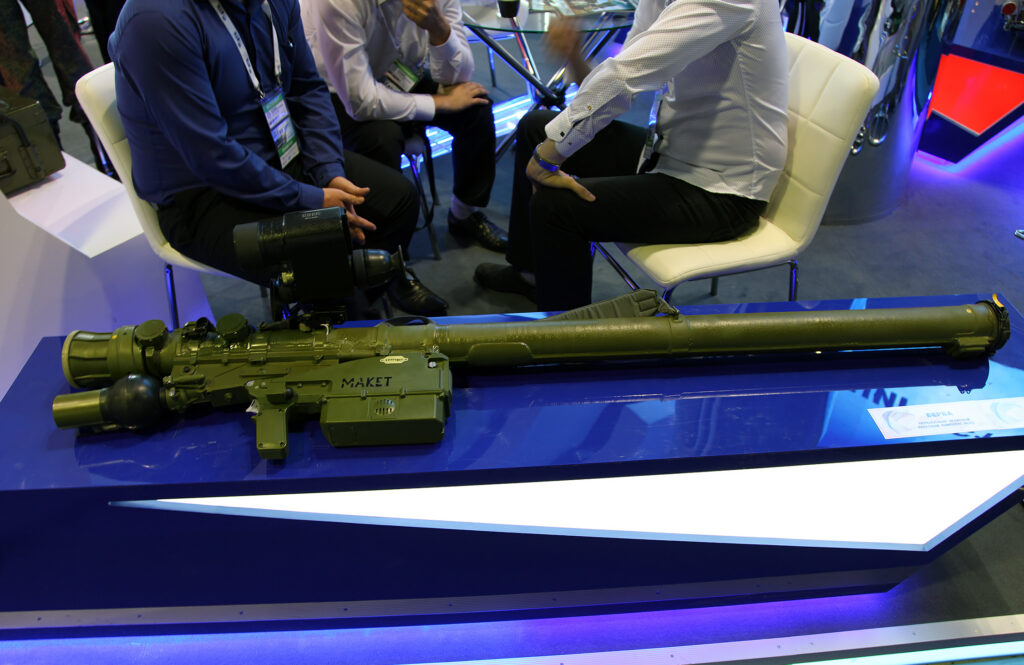
The FT reported on February 22 that, in the weeks after the 12-Day War, Iran opened dialogue with Moscow for its 9K336 ‘Verba’ shoulder-fired anti-aircraft system. Already by December, the two sides inked a procurement agreement worth €495 million ($584 million) that will see 500 launcher units and 2,500 9M336 missiles delivered in three batches across 2027-2029. The report added that some units may have already arrived early in Iran.
Verba, like other manportable air-defense systems, is used to target low-altitude objects such as helicopters and drones. The system can reach targets at altitudes between 10 and 4,500 meters, out to a range of 6.5 kilometers. Russia has supplied the Verba to its own forces and reportedly Armenia as well.
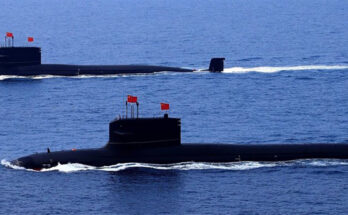
On February 24, Reuters revealed that Iran is negotiating a separate arms agreement with Beijing for the supply of CM-302 anti-ship missiles, the export version of the YJ-12. The media outlet’s sources revealed that Tehran entered talks for the missiles in 2024, and the negotiations became more intense over the summer months of 2025. The sides are reportedly ‘close’ to reaching an agreement.
It is not known how many CM-302s Iran is looking to buy – or when they will be delivered – but introducing the missiles into service would provide a boost to Iran’s coastal defense capabilities. The missile travels at supersonic speed and can hit targets as far as 290 kilometers away, making it a threat for warships and shipping in general, particularly in the congested Persian Gulf and nearby Strait of Hormuz.
Whereas the Verba deal with Russia appears to have reached a contract signature, negotiations for the CM-302 are ongoing, according to Reuters’ sources. The report added that Beijing could ultimately walk away from selling the CM-302 to Iran, given the political context in the Middle East region, where the U.S. is poised for potential military action.
Thousands of Iranians took to the streets in late December and early January to protest deteriorating economic conditions, spurred on by a slump in the rial. The Iranian government initially responded to the unrest by saying it would listen to the protests “with patience, even if it is confronted with harsh voices,” yet Iranian security forces instead launched a severe crackdown that culminated in large-scale massacres from January 8-9.
Days after the massacre, U.S. President Donald Trump urged Iranians to continue protesting in a statement issued on his Truth Social media page, vowing that “help is on its way.” Occupied with operations elsewhere, however, the U.S. did not have adequate forces in the region to confidently perform a mission against Iran at that time, instead requiring the Pentagon to shift combat aircraft, surveillance planes, and two carrier groups to the Middle East over the past month. With the build-up essentially complete, the U.S. is now postured to perform renewed airstrikes should diplomatic efforts fail.
Whether China delays the sale of CM-302s to Iran over the immediate regional climate, the framework of arms control on Iran is in tatters. Moscow and Beijing will continue to seek deals with Tehran, spying lucrative opportunities addressing various capability gaps in the Iranian security forces.

Military markets analyst, covering Eurasia, Middle East, and Africa.